Thursday, 14 February 2013

Game of the Year... 2011

Yes, you read that right, despite the fact that we find ourselves nestling in the dawn of 2013, I'm about to give my 'Game of the Year' awards for 2011. The thing is, just like last year, 2011 was so jam-packed with great releases--most of which took an awfully long time to finish and fully experience--that I simply didn't even manage to play half of the games I wanted to, at least until a good 12 months after their release. Indeed much of my 2012 was spent playing 2011 releases. I've certainly experienced my fair share of last year's highlights; the likes of XCOM, Halo 4, and Mark of the Ninja have not passed me by, and I plan on checking out everything I've missed out on in due course, but finally I can at least say I've played not only every major console release of 2011, but also a huge number of lesser-known titles, downloadables, and even DLC. Thus, belatedly, I can administer my verdict on the best games of what was truly a fantastic year. 

Since there are 12 months in a year and I'll take any excuse to include more games on this list, I've decided to compile a 'Top 12', hardly the most-common numerical choice for this sort of list but frankly I feel the number ten gets far too much airtime these days, twelve is far more sensible. I'd also like to preface this with a small note: this list is my own personal preference, simply the twelve games I enjoyed the most, some of them will have been on almost everyone's lists, a couple probably won't, but in no way is this an assessment of quality. Enjoyment is what I want from a game and enjoyment is the factor that decides this list. I could very easily--if reluctantly--argue the nonsensical semantics of why game X is better than game Y but frankly that's not why I'm here. Video games, like any form of entertainment, are a very subjective matter and there will always be plenty of people who share a very different view, anyone in the business of sharing their opinion has to face up to this simple truth. So, without further ado, here goes the first ever Attack Button Game of the Year awards.


Honourable Mentions


Ah the honourable mentions. Yes of course, where would any self-respecting, sympathetic list be without the honourable mentions; those games that I simply adored but not quite enough to make it to the final dozen. They shall not be granted the prestige of a paragraph of praise and accompanying picture, but they were brilliant nonetheless. Here's why, along with a few reasons they didn't quite make the cut for me.


Portal 2 - I adored the first Portal, and frankly my feelings for the second were no different. Valve improved the game in virtually every possible way, building on the story with some surprising plot revelations and entertaining voice-acting, and giving us plenty of new toys to play with. The co-operative game was an absolute blast to play through with a friend, and a lot of care clearly went into Portal 2's production. Unfortunately, I enjoyed the experience less and less as the game wore-on, and the humour began to grate on me; I shamefully regret that I seem to be one of the only people worldwide who didn't find Cave Johnson funny in the slightest, but there you have it. 

The Gunstringer - Twisted Pixel's Kinect-exclusive tale of a sheriff marionette risen from the grave and out for revenge was a wonderful surprise of 2011. Not only did it take fine advantage of the Kinect technology, but offered a laugh-ridden campaign that failed to fall into the motion-control trap of gameplay gimmicks. Despite The Gunstringer being a fairly repetitive experience and unfortunately suffering from some hardware-integration issues, it is one of the only Kinect titles to date that actually feels like a real video game, and TP deserve plenty of praise for realising such an apparently lofty goal. The free DLC that shipped with the game, 'The Wavy Tube Man Chronicles', was also absolutely brilliant and I hope we'll see more great work with Kinect from this developer in the future.


Modern Warfare 3 - With another year came another blockbuster in the Call of Duty franchise. As far as those games go, my interest has varied over the years from 'mild indifference' to 'rabid fanboy craze', and Modern Warfare 3's release saw me transform somewhat closer to the latter. Whether or not you adore or detest the franchise, I find it hard to mount a cohesive argument against the quality of Call of Duty's raw gameplay and the stupidly addictive nature of its multiplayer. Yes these games are completely unrealistic, yes the multiplayer can be an unbalanced mess, and yes this thing is the biggest cash cow in the industry, but so what? Just as there are nights when I'd rather watch a bit of Commando than The Hurt Locker, there are times, especially in video games, where I just want some old-fashioned, stupid fun. CoD has, at the very least, provided that in spades for a good few years now, and Modern Warfare 3 was no exception. The campaign, while being about as mind-meltingly Michael Bay as you can imagine, provided a fitting end to the most profitable video game trilogy of all time, and countless nights in front of the console were guaranteed for fans the world over as the game's multiplayer and co-operative offerings continued to expand. Personally, I felt a little burnt-out on the game after a couple of weeks, the multiplayer did little to grab me and I never got back into it, but MW3 deserves plenty of praise.


Saints Row: The Third - Well, well, well, the franchise that began as nothing more than a fairly-meagre GTA clone has gone on to not only match its influence, but exceed it. Some of the most hilarious writing, most-involved customisation, and most addictive open world gameplay of all time made the third Saints Row game an utter joy to experience from beginning to end. Not only hearkening back to the days of the more crazy GTA games, but topping them in nearly every way and delivering what the Saints Row franchise initially never looked capable of: a wholly unique experience. Sure, the story itself was threadbare, the difficulty seemed to jump about all over the place, and unfortunately almost all of the game's DLC has failed to match the quality of the full product, but Saints Row: The Third was the booster injection of fun for which the open-world, gangster genre was sorely overdue.


Batman: Arkham City - Anyone who has played an Arkham game would tell you it's not just the intuitive combat, the gargoyle-clad stealth rooms, or the Riddler puzzles that make it special, it's the whole package. When you put so many brilliantly-polished mechanics and features together, the result is a shining example of what a video game can be. That's what Arkham Asylum was. Arkham City, at least from my point of view, was just more of that. Now, I'm not one to argue against 'more brilliance'; 'more brilliance' is, by definition, a wonderful thing and I very much enjoyed spending more time in this particular vision of Batman's world. However, I was left feeling that very little had been done to improve the formula. Sure, its a winning formula and 'don't fix what ain't broke', but that sort of excuse has never been enough for me. I felt as if Rocksteady were doing nothing more than riding the success of the first game, and even then, it was a bumpy ride at times, with the game's story becoming something of a convoluted mess as one-too-many villains were shoehorned into the plot. The only major gameplay addition came in the form of Catwoman as a playable character, which I personally could have done without. Don't get me wrong here, I adore both Arkham games and am confident in Rocksteady's ability as a developer, but I sincerely hope, if there is another of these games, that they have enough confidence in themselves to shake things up a little.


12 Shadows of the Damned


Just about making the list is Grasshopper Manufacture's punk-rock, action horror. What the game lacked in gameplay, it more than made up for in character. Garcia Hotspur became one my personal video game icons and it only took him a few hours of gameplay to do it. Not to mention his witty sidekick Johnson, who acted as a fine cowardly counterbalance to Hotspur's brutishness. The pair were an instant hit, and represent all that I loved about Shadows of the Damned. It was stylish, it was hilarious, it was undeniably cool, it didn't take itself too seriously, but knew it had a damn fine world to show you and a kickass story to boot. It was an experience like no other in 2011, an impressive feat considering the raw gameplay itself might well have been Ctrl+V'd from any other third-person shooter. But Shadows of the Damned was about more than pressing buttons and shooting dudes; it was about the ride, and it was one I haven't forgotten.


11 Rise of Nightmares


Part of the reason I loved Rise of Nightmares so much was because it stood out. Even now, nearly eighteen months on from its release, it remains one of the only Kinect games that really tried to, well, be a video game. And for the most part it succeeded. The team at Sega Wow did what virtually every other Kinect-developer has failed to do; they didn't see the device as a hindrance, as something to be worked around as best as possible with shortcuts and handholding, they didn't even see it as a piece of serious hardware that should be treated delicately to cater to a 'hardcore' crowd. They saw the mad little toy that makes people the world over flail their limbs about in the living room like madmen. They saw what is, for now, the essence of Kinect: a kinda broken, kinda stupid thing that can actually be a whole lot of fun if you don't take it too seriously. They said let's make a game for that. And that's just what they did. Rise of Nightmare's cliché-ridden, hilarious B-movie horror, combined with surprisingly varied gameplay, remarkably intuitive control systems, and more wacky gestures than you can shake a leg at, more than cement it as one of my favourite games of 2011.


10 Dead Rising 2: Off the Record
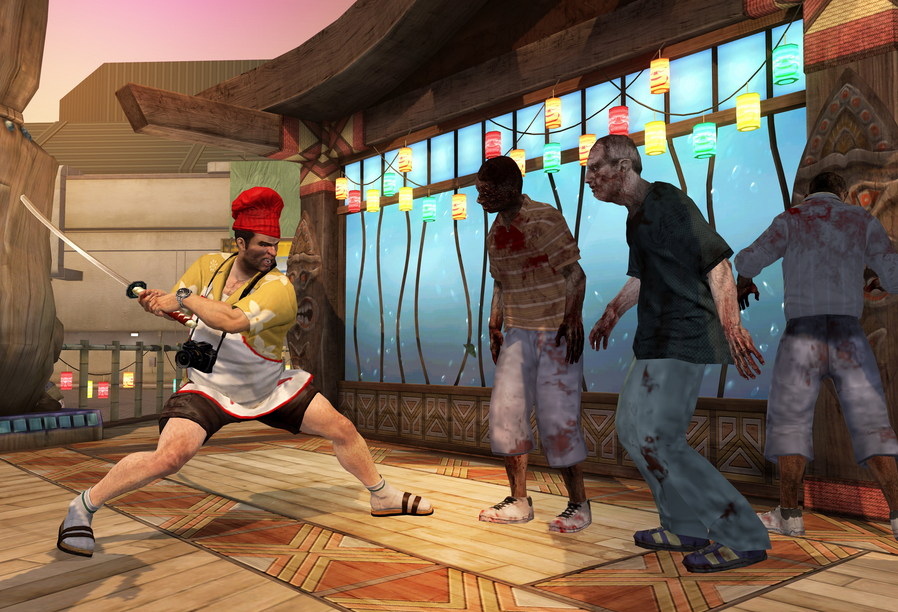


It seems that not a lot of people noticed Dead Rising 2: Off the Record. For a variety of reasons it slipped under the radar, but I would implore any Dead Rising fan, or even anyone with a passing interest in the franchise to pick it up because it is, quite simply, the best game in the series. Finally the folks at Capcom paid attention and made some of the changes fans and detractors alike had been clamouring for. The introduction of a sandbox mode was a much-welcome feature, eliminating the pesky time limitations and letting players get down to the meat (or perhaps flesh?) of the Dead Rising experience. Snapping "erotic" photos again felt like being reunited with an old friend, and at least on a personal level, the most important addition of all was the return of perhaps the world's favourite wartime photojournalist, Frank West. The developers took the time and care to not just rush out a re-release, but really make a product worth the money. The completely re-imagined story, along with the new area, weapons, and psychopaths all contributed to making the game more than justify its creation. There are still things in the Dead Rising formula that require a bit of tweaking but Off the Record improved far too much to be ignored. In short: fantastic!


9 L.A. Noire


L.A. Noire was something special, not just in the way it went about using its marvellous MotionScan technology to present lifelike characters, but in everything else it did too. The interrogation mechanic was something else, and the way in which Team Bondi went about converting the methodical, slow-paced style of an adventure game into an open world was a stroke of genius. Not to mention they wrapped it all up with an emotional story, and decorated the game with just the right degree of raw brutality and dark corruption to capture the fragility of post-war Los Angeles, and its inhabitants. The game was a triumph; a sterling example of storytelling, artistry, and remarkable technology. The tale it told left a lasting impression on me, as did the characters I met along the way. The pleasure of donning my sleuth cap and sussing out--or at least attempting to suss out--each crime was the realisation of a childhood dream. I can only hope we see more games taking inspiration from L.A. Noire in the future.


8 Ultimate Marvel vs Capcom 3


I'm hardly a fighting game pro but this game made me feel like one. Capcom's fantastic design allowed rookies to pull off 100-hit combos and screen-filling ultra moves with ease, while meticulously balancing each member of the game's huge roster to suit the competitive community too. The inclusion of well-made challenge and training modes only eased the introduction for less-experienced players, and the overall accessibility of the game is one of its finest attractions. Fights themselves are truly a spectacle to behold, with utterly sublime graphics and magnificently-detailed animations. You'll never see a slow fight in MvC 3 and the game does a sterling job of essentially capturing what you would expect a battle between the likes of Ryu and Wolverine to play out. The initial release of the game would've made the list by itself, such was the quality of the core game, but the Ultimate edition really completed the package. The addition of so many new characters and stages was enough to sell me on the product, but Capcom went above and beyond, tweaking and re-balancing each character, adding a spectator mode that was sorely-missing in the original, throwing in a free downloadable--and completely wacky--card-based bonus mode, and even the little novelty additions like playable Galactus went a great way to making Ultimate Marvel vs Capcom 3 fantastic value. The attention to detail on display from the developer, and the care they invested to make a truly accessible fighting game was a gesture I fully appreciated, and to this day UMvC 3 remains one of my all-time favourite fighters. 

7 Mortal Kombat


Just edging ahead in the fighting game stakes is Mortal Kombat. This is a franchise that, at least from my point of view, trod a drastically fluctuant path since the turn of the millenium (and perhaps even a little bit before, the less said about Mythologies: Sub-Zero the better) and fans--myself included--were, understandably, rather equivocal in our expectations towards this new game. But as more footage was released, doubts were vanquished and excitement grew, with good reason. Mortal Kombat (9) is a sensational video game, and the perfect example of how to reboot a struggling franchise. Netherrealm took MK back to its roots, whilst adding a modern touch to spice things up. All of the game's classic characters returned, and each was designed and balanced so well that I found it impossible to decide on a favourite. It was one of the only fighting games in recent memory to feature a full story mode that actually made sense, and evidently a lot of attention went into providing as full an experience as possible. The Challenge Tower was an addictive and varied addition, while the game's multiplayer--the lifeblood of any fighter--was handled very well, with the theatre-style spectator mode a nice touch. Roll on Injustice!

6 Deus Ex: Human Revolution


Human Revolution surprised me. I'd never been much into Deus Ex before, I played and enjoyed the first game enough but never really invested myself in the series. Picking up a copy of HR, I expected a decent little stealth romp to kill a weekend. What I found was an awful lot more; a wonderfully-imagined, and rather scarily realistic cyberpunk vision of the future; a story wrought with intrigue, fascinating science, and conspiracy; and some of the most dynamic gameplay I've seen in the last few years. To top it all off, the game handles stealth--should you choose that particular path--brilliantly, with some truly challenging segments, multiple pathways through nearly every area, and countless options to deal with the enemies you face. The quality of the story missions can't be understated, but it was outside the core game that I really found myself falling in love with HR. There's such a lot to explore in the game, so many computers to hack, well-written side missions to undertake, and secrets to find, and all of this content is such a lot of fun to discover. A hallmark of a well-made game is a world worth exploring, and Deus Ex: Human Revolution can safely check that box.


5 Dead Island


Oh Dead Island, you were the zombie game I've always wanted. You took zombies and made them scary, something that an awful lot of developers have been unable to do. You built a world that really felt like it had been overrun with the undead, complete with the raw helplessness and terror that we imagine would come with it. I felt genuine dread at the prospect of running from one end of a city to the other, sure in the knowledge that the fight for survival would be a tough one. A fight with more than a few zombies was a true challenge, and the wild howls of the lethal infected would send a shiver down my spine. Dead Island did so many things right that I was more than willing to overlook its minor flaws, and I feel anyone else should be too. Techland crafted a survival horror experience that was simply fun to play, with an intuitive combat system, a ludicrous amount of content, and a co-operative game that can't be missed.

4 Rayman Origins


It's hard to put into words just how much I adore Rayman Origins. As a lifelong fan of the limbless wonder, I don't think anybody could've been happier than me to see his return to the two dimensions from whence he came, and a big, beaming smile didn't leave my face from the moment I picked up the controller until I set it down. The game is beautiful. In fact, let me just say that again for emphasis; the game is beautiful. It is an utter joy to make one's way through each and every wonderfully composed level, accompanied by a cheerful soundtrack every bit as gorgeous as the world that dances to its beat. The nicely-balanced difficulty, hilarious multiplayer, and hours of potential replayability were generous sprays of polish on an already shimmering game. Rayman Origins is a consistently blissful experience from start to finish, and I was truly sad to reach the end; which is not something I feel very often. 

3 Gears of War 3


It's amazing just how good Gears of War 3 is. After the original blockbuster, and it's more than impressive sequel--a game that more than managed to deliver on the developer's promises of a "bigger, better, more badass" experience--I admit I felt some trepidation going into the final chapter of the trilogy. Could they really do it again? How can you possibly improve on a game like Gears 2? Well, as it turns out there's an awful lot of answers to that question, and Epic Games knew them before the rest of us. Gears 3 was the ultimate package, an explosive campaign saturated with some truly great storytelling, the horde and beast modes that surpassed their peers and cemented Epic's place as masters of their own innovation, and, perhaps best of all, a balanced, addictive, and superbly refined multiplayer. The game captured every aspect of the franchise that people adored, polishing each to a gold standard and throwing in plenty of new tricks to keep it fresh. It not only surpassed its outstanding predecessors, but somehow made them look puny and hollow when put up against such a masterpiece. As we now know, it wasn't the final Gears of War game and I can only hope Judgement delivers this year, but I won't believe it until I see it. After all, how can you possibly improve on a game like Gears 3?


2 The Elder Scrolls V: Skyrim


How can one summarise Skyrim in a paragraph? After spending my first hundred hours in the game's world, I felt like I'd only just scraped the surface of what that game has to offer, and I remained just as eager to see it all as when I began. It's more than a game, it's another world. A living, breathing, wonderfully-built world that you want to explore. The fiction is rich, the scenery beautiful, the adventuring wild and the quests innumerable. It feels as though you're living another life. The freedom the game offers you only enhances this, and it's something I feel other developers could learn a great deal from, as well as the reason I adore the Bethesda RPG model more than any other. They don't confine you, shepherd you along, hold your hand or tell you what to do. Skyrim teaches you its basics and sets you loose, there's a hell of a lot out there to discover and Bethesda are confident that whatever you find, whichever path you take, cave you explore, town you terrorise, or quest you undertake, you'll be desperate for more. They're right.

1 Dark Souls


Yes, as you may have guessed, Dark Souls takes the 2011 crown. What can I say that I haven't said already? I've spent over three hundred hours on this game now, completed it over a dozen times, and I continue to fall deeper in love with each passing minute I spend in the world of Lordran. People talk about the similarities between Dark Souls and Demon's Souls and they're certainly there to see, but From Software didn't just build on a solid foundation, they went above and beyond. Preserving the intense difficulty and dark fantasy adored by many in the first game, they crafted a whole new world even more intriguing, mysterious and unforgiving than the last. They built an experience that functioned on a completely different level to most video games, centrally-focused around the ideas of challenge and achievement through a combat system that taught players to learn from their mistakes. It says it all when the game took me about fifty hours to complete first time through, and now I can finish it in around five. And in spite of what little value that achievement really holds, I'm proud of it. I've "beaten" an awful lot of games in my times but Dark Souls is the first I feel like I've truly "conquered," and I'm still desperate to play more. In the same way that my character has levelled up over time, I too felt like my own stats were rising, my dexterity piqued after countless battles, my foresight matured through my adventures, and my strategies honed through repetition. Everything about Dark Souls is handled in a way that appeals to me and my sensibilities, from the lore that isn't thrust into your face with hours of cut-scenes, but delicately gleaned from your interactions with the world itself, to the boss battles that feel every bit as grand as they look. It's an incomparable video game experience, and the best I had in 2011.

Tuesday, 29 January 2013

Review: The Binding of Isaac

Biblical influence, faecal matter.


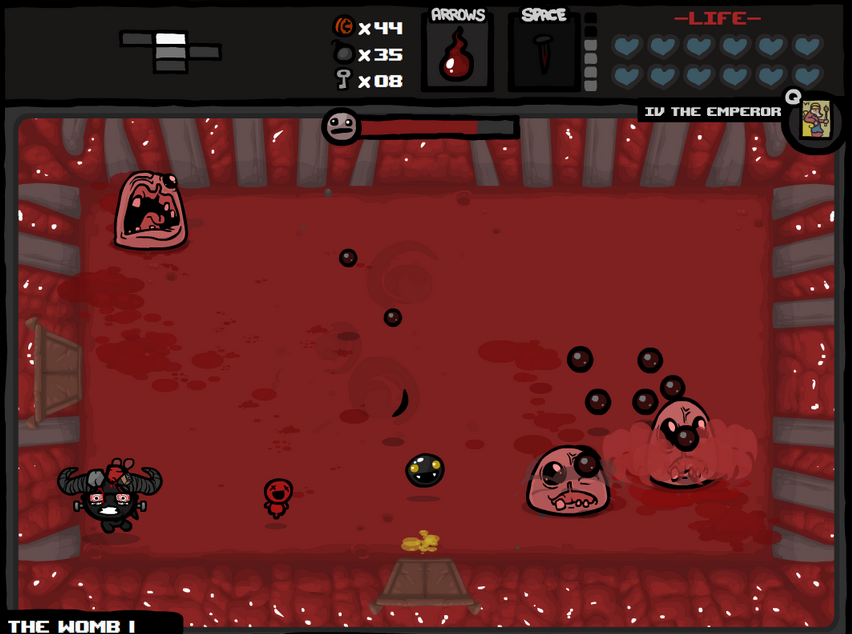
Yep, tiny crying boy versus monstrous, skeletal spider thing; sums up the game really

There's an enemy in The Binding of Isaac; a little maggot that slithers along the ground slowly. With big, bright eyes and a cheery smile on its cute, little face, it whimsically wanders about in random directions, minding its own business and enjoying the scenery. Until it spots you. Then it gets angry. And that mouth you thought was cute? It's now wide open, revealing a set of dentata that wouldn't look out of place in a Lovecraft novel. The way it slowly slithered about? It's now charging right for you hell-for-leather. This little maggot? It is The Binding of Isaac. A game with a cute and fluffy exterior, hiding a viciousness that will rip you apart and eat the pieces. What else did you expect when your primary weapon is a child's tears?

Binding (which I'll refer to it as from now on, just a little time-saver) is a roguelike game. Now, considering the recent influx of this style of game, the term has become more widely-known, but not to the extent where I feel comfortable throwing it about with no explanation. Thus, for anyone unaware, a roguelike is an RPG usually displaying the following features: randomly-generated levels, permanent death, and turn-based movement/combat. Binding has two of the three, with the latter being abandoned in favour of a more action-heavy, real-time combat system. The genre also typically relies on the theme of discovery, along with intense difficulty that demands a high degree of concentration. Binding is no different. It will kick your ass time and time again.


I wish I had something to say about this scene... but I don't

The game tells the story of, unsurprisingly, a lad named Isaac. Taking obvious inspiration from the biblical tale of the same name, Isaac's mother receives a message from God instructing that she sacrifice her young son. She attempts to dutifully oblige, brandishing a scary-looking kitchen knife and making her way to Isaac's room. Luckily, the little scamp spots a trapdoor in the floor and makes good his escape. Unluckily, his "escape" leads him to a labyrinthine basement, full of unworldly terrors. This is undoubtedly the most unfortunate event to befall young Isaac, but not the first, as the game's loading screens show him being bullied and humiliated in all manner of ways. In a way, Binding is the ultimate unlikely hero story. Isaac is a punching bag; a puny, little runt with a mother that wants to kill him, peers that degrade him, and all manner of nasties out for his blood. Yet, despite everything that happens to him--and trust me, a lot of horrible things happen to him--he keeps going and maybe, somehow, he might just overcome the odds and get through this after all. It's up to you to guide him there, and you'll have to be either very good or very lucky to make it. The game has over a dozen endings, and it's great to see the care and humour of the game's art-style crosses over to the story too.

Speaking of the game's look, it might just be the most striking feature of the whole package. Edmund McMillen continues right where he left off after Meat Boy, with a chunky-outlined, cute/gore mashup style hovering somewhere between The Powerpuff Girls and Ren and Stimpy, with a whole lot of darkness and toilet humour thrown in for good measure. The game's dungeons are flooded with faeces, flies, and fearsome fiends, with the bosses in particular being of startlingly gruesome design; from incontinent blobs of flesh to giant burrowing worms. In spite of the game boasting a world rich with bodily-fluids, monstrous creations, and body horror, the times are plentiful where you simply can't help but chuckle at the sight before your eyes. Well, you'll either be chuckling or wretching since the gross-out factor of the game cannot be understated; a simplistic cartoony-style isn't enough to shield your senses when you utilise "Mom's Pad" as a weapon. This is a game where you play a child, thrust into a basement stark naked, and forced to use your own salty tears to break apart piles of excrement, in the hopes of finding coins to pay for a rock to stick into your head and make you more powerful. Frankly, I must pay testament to the art and humour that goes some way to bringing levity to such ludicrously dark proceedings. Nevertheless, the style of the game will naturally prove divisive, but those who like it, will really like it.


It's just apple juice, honestly

So how does this thing play? Well, it's actually pretty simple. You find yourself in a randomly-generated dungeon floor and move from room to room, defeating enemies as you go, while collecting keys, coins, bombs, and all manner of special items. Your objective? Survive, defeat the boss, and make it to the next stage, with your ultimate aim being to defeat your mother in glorious combat. Said combat takes the form of a basic shoot 'em up, with Isaac able to shoot up, down, left, and right, with circle-strafing his strongest ally. Three rooms are more or less guaranteed on each floor: a boss room, a shop, and a treasure room. But there are all sorts of other secret rooms to find, from the "Sacrifice Room" which offers you the chance to spill your own blood in exchange for prizes, to the "Library" which, as you might expect, contains all manner of books for you to make use of. You'll need them. You'll need everything you can get, and boy is there a lot to get in this game. A regular feature of the roguelike genre is a sense of discovery, and Binding incorporates this to maximum effect. There are more items in this game than you can count; an incredibly impressive feat when one considers that this title was made by only two people. Every item has a distinct use, making each feel different than the last, and often is the time you won't really know what each thing does until you use it.


This all works to Binding's benefit in the end; since the frustration of death--which occurs pretty often--is cushioned by the excitement of restarting just to see what you'll find. The fact that most items completely change the look of Isaac, along with your own playstyle, only adds to this. You might find a bent spoon that gives Isaac a flaming third eye in the centre of his forehead, and the ability to shoot purple homing shots, or a little floating baby that acts like a Gradius option or familiar, shooting out its own tears in support.The things you find might even make you chuckle, with items referencing the likes of Super Meat Boy, Magic: The Gathering, and Arrested Development. The phrase "No two playthroughs will ever be the same!" is thrown around an awful lot these days, conjuring images of variety that often disappoint, but Binding absolutely does it justice. With so many things to find, so many different rooms, enemies, and bosses, and so many variations of Isaac--or indeed any of the other six playable characters--to discover, you'll have a different experience every time.


Isaac's time in the basement can change him in all sorts of ways

Thus, we come to one of the unfortunate side effects of such a system; since some items and combinations are so much more useful than others, the luck of the draw winds up having as much influence on your progress as your own personal skill level. It took me an awful lot of tries to complete the game, and when I finally did it was only on a run where I'd been fortunate enough to find the most powerful standard weapon, a familiar, the ability to see the entire map, an excellent secondary weapon, and the ability to fly. My next run saw me grab nothing but a couple of health boosts and bonus bombs. Now, I make no claims at being an expert at this sort of game and I can imagine plenty of people with good skill levels can complete it even with the very worst items, but I can only report from personal experience. Yet, in spite of the mild frustration one might feel at spending their last key on a treasure room and being rewarded with naught but a useless random teleport ability, you have to accept it's all part and parcel of the experience and I wouldn't have the game without it.

Unfortunately, the game suffers from a couple of issues that aren't quite so defensible. A lack of proper controller support is hardly crippling, but remains a hassle that might have been avoided rather simply. Yet the real problem is slowdown; the game was made rather hurriedly in Flash, and unfortunately struggles almost any time there's a lot happening on screen. Upon researching this issue, I've discovered that it is a rather common fault, and occurs even on top-of-the-line machines. I must regrettably recount that it may in fact be considered gamebreaking by some; with the game regularly stuttering to a veritable crawl even on low settings. This appears to be an issue that won't affect everyone, and I hope that others will be far luckier than myself, but it's very much worth bearing in mind before making a purchase.


It's testament to the game that in spite of such an issue, I haven't been able to stop playing it and can do nothing but recommend it. The Binding of Isaac is a wonderful example of where the industry is nowadays, if a team of two can turn out such a deep, engaging, addictive, witty, and most importantly enjoyable product within such a short amount of time, then the mind boggles at the future of video games. The game upholds the standards of its genre, capturing the senses of discovery and difficulty that make a roguelike fun to play, whilst overcoming the seeming inaccessibility of this style of game. With the most hideous of design, the darkest of humour, and the most unforgiving of difficulty, one would expect this game's appeal to be about as limited as possible; yet, through the developers' mastery of their craft, with a careful application of humour, self-awareness, and modern ideas, Binding becomes more than the sum of its parts. It is a complicated game, shrouded with a visage of complexity, and I would implore anyone on the fence to take a peek behind the curtain. There's something pretty savage back there, but you might just love it.

Thursday, 10 January 2013

Review: Offspring Fling!

Look before you chuck!


Nawww
From the mind of budding indie developer Kyle Pulver comes yet another retro-styled puzzle-platformer. Offspring Fling! follows the maternal exploits of a fuzzy, yellow bird as she attempts to rescue the little hatchlings she has unfortunately misplaced. How does she go about saving her spawn? By hurling the adorable furballs all over the place. Frankly, I'm a little astonished the species has made it this far, but luckily the chicks seem to possess skeletons that would make Wolverine blush, and can take being smashed against a wall without even the unsightly inconvenience of a bruise. Be that as it may, they're not immune to acid pools and giant hornets, so it'll take every ounce of mama's efforts and your brainpower to suss out the more complex stages and--I can't believe I'm saying this--throw her children carefully.  Nowadays, bird-throwing is becoming something of a subgenre in gaming, but worry ye not innovation-enthusiasts, Offspring Fling! is not the Angry Birds clone its premise might suggest. In fact, it's completely incomparable to the smartphone sensation, focusing instead on a wide variety of evolving action puzzles, with plenty of new hazards and tricks thrown your way with each passing stage.

You don't even have to load this one up to see where its influences lie. Everything about the game screams 16-bit homage, from the trailer sporting an amusing 'Super Pretendo' logo, to the game's cutesy graphics style, two-button control scheme, and simplistic premise. This is the sort of game you really could cut and paste to an old SNES or GBC cart and convincingly pass off as the real deal. Frankly, there were times when I wished it were an old SNES game, if only for the benefit of being able to use a controller. The game's default control scheme--using the arrow keys for movement and Z/X for actions--is frankly diabolical, but even reworking things to WASD provides little improvement. The game's platforming isn't too demanding, too often, but when it is you really begin to notice the awkwardness of the keyboard. Hardware isn't the only culprit here though, the mama bird has something of a floaty jump and difficult sense of momentum, she's one of those rebellious, little characters who just doesn't quite feel ready to respond to your inputs. The game is hardly Super Meat Boy, but at times seems to demand a more accurate control scheme than it bears.


Nintendo could probably sue but who even cares?
Fortunately, the game's progression system helps to make up for its shortcomings in the control department (as does the in-built pad support). Beating levels earns you flowers, beating par times on levels earns you gold flowers, and beating the almost godlike developer times earns you rainbow flowers. What do flowers unlock? Levels! Thus, you'll nearly always have a pretty big choice of available stages, and can jump in and out as you please, skipping the more difficult challenges altogether if you so desire. It's a system Pulver utilised again recently in Snapshot and it works just as well here but, as I said with that game, it can only mask the game's flaws, not erase them. Again, as with Snapshot, it's nice to see the par times thrown in to offer a bit of replayability, and a bonus layer of challenge. Speaking of replays, the game saves ghosts of your best times to race against, and these can even be uploaded and downloaded from the net to really see who is the best fowl flinger. 

The levels themselves are more or less what you would expect. The game, just like plenty of other titles in the genre, has a core mechanic and squeezes a whole lot of mileage out of it. All each stage asks is that you collect your babies and bring them, and yourself, to the exit unharmed. From the humble beginnings of hurling one chick over a gap, right up to levels where you're juggling half a dozen of the sprogs, setting them down on buttons and catching them in mid-air, all while evading killer wildlife. In spite of the huge number of levels and the carefully-paced difficulty curve, I never actually found myself stuck for more than a minute or two. Perhaps the capacity for complications is somewhat limited by the simplicity of the game's mechanic. After all, being able to pick up, throw, and put-down objects is hardly a novelty in video gaming. There really are only so many things one can do with this idea, but you can't fault Pulver's level design; an awful lot of content is eked out of a basic concept. Unfortunately, for the most part, said content doesn't particularly do much to either tease or tingle your brain, and it's all a bit too ordinary. There's a level editor available to download, so maybe the community at large might be able to come up with something special, and at least fans of the game have a way to extend their playtime.


Look at all the retro
Thus, if there's any area where the game falls short, it's unfortunately a biggie. Unlike the Braids and Closures of the world, or even Pulver's more recent offering Snapshot, Offspring Fling! doesn't give you that sense of accomplishment, those "Aha!" moments. I enjoy a puzzle most when, upon solving it, I feel both bewilderment at the intellect of its designer, and pride in my own. Unfortunately, this game never treated me to these emotions. Not once. I completed it in under ninety minutes, and even then barely felt like I'd particularly achieved anything. I'd hate to say the game's too easy, and I don't think it is, but its mechanic is too easy. I spent my whole playthrough waiting for Offspring Fling! to do something out of the ordinary, but it never quite does. The game is cute and simple, that's what it sets out to do and that's what it achieves. Such fast-paced simplicity lends it the feel of an iOS title, and I can't help feeling it would be more successful on that platform. Essentially, this is very much what our modern-day parlance would label a "casual puzzler." There's more than enough fun to be had with it, and for those who often bemoan the difficulty of the genre, this'll be right up your alley. But for the serious puzzle-solvers out there, the only challenge you'll find here is getting to grips with the controls, and mastering each stage to muscle memory in efforts to beat the par times.

Having recently played Pulver's latest game Snapshot, I'm compelled to draw similarities. In both, we have around one hundred levels of puzzling action, with a carefully-plotted difficulty curve, and enough fresh ideas to keep the game from at least getting stale. In both we rely on some cute designs and smart stages to push us along, with neither game presenting much in the way of story. Both are well-made, both are fine little ways to kill a few hours, both are, ultimately, nothing too special. I can just picture the remarkably cute, little chicks of Offspring Fling! looking at me with teary-filled eyes right now as I denounce their game, but--I'm sorry little munchkins--it's the truth. Perhaps, in an effort to emulate the styles of old, Pulver went too far with this one and created a game that certainly would've flown out of the nest in 1992, but can't quite stand-up in 2012. Don't get me wrong, the game has a brilliant look, a super soundtrack, and is a perfectly pleasant way to spend an hour or two, just don't expect that hour or two to be all that memorable.

Friday, 28 December 2012

News: Humble Bundle 7 Gets 3 New Games

That's right, even more reasons to buy the thing you already had SO many reasons to buy!

You too can receive an email just like this one by signing up at www.humblebundle.com
Despite already boasting the likes of Legend of Grimrock and Closure, the folks over at Humble Bundle clearly felt that their latest-offering could do with an extra helping of brilliance (it is Christmas, after all). Thus, for the next five days, you can get your hands on not only these great games, but three extra titles too. These bonus games, as mentioned in the earlier article, are locked behind the average price barrier (which just happens to be $6.52 at the time of writing), but anyone who already bought the bundle gets them absolutely free regardless of the price you paid. 

So what are you getting? Let's begin with Offspring Fling - this one-man creation perfectly emulates the look and feel of the great puzzle platformers of yesteryear. Featuring over 100 levels, an art style reminiscent of the SNES era, and some of the cutest pixelated critters you ever did see, it's already worth more than the asking-price. Next up there's Cave Story+, the critically-acclaimed 'Metroidvania' homage. A true platforming-adventure echoing the style of 8-bit classics, while injecting just the right amount of modernity, with a soundtrack that is, quite frankly, aural gold. Finally, and perhaps most interestingly, we have The Basement Collection; an assortment of Flash games created by none other than Edmund McMillen (yes, he's certainly getting a lot of coverage in this particular bundle). The collection features Meat Boy, Aether, Coil, Spewer, Triachnid, Grey-Matter and Time Fcuk, along with a whole mess of unlockable content. If you haven't heard of some of those titles then don't worry, I haven't either, but since they're from the mind of the man who gave us Super Meat Boy and The Binding of Isaac I'm eager to check them out.

So Humble Bundle 7 gets even better and frankly I can't think of a single person I couldn't recommend it too. More great games have been added to an already fantastic collection, and you've only got a few days left so please do get at it. It'll certainly be a little while before another package like this comes along so I'd encourage everyone to take advantage while you can. Expect more reviews of the Bundle games in the coming days. 

Tuesday, 25 December 2012

Review: Snapshot

World Press winner or Facebook profile pic?


Imagine how useful this would be in real life
If I were to list the modern trends I find most frustrating then obsessive photography would have to be near the top. These days, everyone and their mum seems to find it necessary to assemble a digital catalogue of their daily goings-on, with budding photographers the world over force-feeding us countless, frozen captures of their lives on a constant basis. Perhaps in an effort to satirise our snap-happy society, Snapshot--the latest in the long line of puzzling-platform-puzzle-platformers--is entirely-focused around a magical camera, with the ability to store real-world objects inside photographs, and re-distribute them about the world as you please.

This wondrous ability is one that, as you might imagine, can be used in all sorts of inventive ways and Snapshot makes great use of its core mechanic, quickly building up from straightforward crate-stacking to reflex-based mid-air photography, throwing a wide range of hazards and tricks in your face as the game progresses, and even incorporating the laws of momentum to create some truly devilish late stages. The difficulty curve is an important factor of any puzzler, and I'm pleased to report that developer Retro Affect succeed with aplomb in this respect, the game ratchets up the challenge at a fine pace, and no two puzzles out of the near one hundred on offer are ever quite the same.

Along with an impressive number of levels, the game features acres of replayability for those who care to indulge. Each level has stars to collect, a hidden item to photograph, and a par time to beat. I wish I could tell you what all of this unlocks, if anything, but the secret items are, at times, concealed amongst the narrowest of pixels, while the par times are very tough to better, often demanding absolute precision from the game's less-than-absolutely precise controls. In any case, I personally haven't felt a strong enough inclination to seek everything out, but this stuff is there and suffice it to say, it's a completionist's dream (or nightmare, depending how you see it). Whether or not you'll summon the desire to seek these secrets out and grind out lightning-fast times is perhaps besides the point; the designers must be commended for including so much relevant content.


Look at all those lovely medals to nab and secrets to collect
Unfortunately, it isn't just the puzzles and par times that'll dish out a dose of frustration. The controls can hardly be labelled poor but in this sort of game, where pinpoint accuracy is often required to complete the more intricate stages, and the slightest misplaced jump or photograph will lead to certain death, it's a real shame that the controls so often fail to live up to the game around them. The system itself couldn't be more intuitive; guide your little robot Pic about with the keyboard while flying the camera around the world and snapping pictures with the mouse. It's a fine example of smart design, and testament to the talent at Retro Affect, but it simply isn't refined to a high enough standard here. The annoyance I felt each time the mouse decided to seemingly triple its sensitivity as I sought to carefully rotate a photograph to the correct angle, or the anxiety I'd experience just before the last jump of a level in case I hadn't quite judged it right and fell to my doom wouldn't have been so bad if it didn't occur so often

As you can imagine, there's a fine sense of injustice and frustration after you've spent time solving a level's puzzle, particularly some of the more difficult stages that require some very tight timing, and then find yourself in a fail state and forced to restart the whole darn thing after one little mistake that you don't really feel was your fault. It's an unfortunate issue that one feels could've been solved quite easily with an undo button or checkpoint system. Luckily, each level is a relatively concise, bite-size chunk; it never really takes too long to redo one's progress, especially after you've sussed the puzzle, and there's usually a wide choice of available stages to jump into, so if anything gets too frustrating you can always come back to it later. This stuff helps to hide the game's issues, but not erase them, and it simply has to be said that your temper will endure some gratuitous trying times throughout your Snapshot experience.

Visually, the game can be taken in one of two ways. On the positive side, I could mention the way it reminded me of classic Kirby, with a simplistic, yet colourful and tidy composition. The environments are hardly original, but pleasant to traverse and there's enough variation in design to keep things from getting too stale. It's a somewhat refreshing change of palette in a genre dominated by obscure styles, like the harsh monochromatism of Limbo or Closure. On the other hand I can say that at least games like those, and even more colourful fare like Braid or Fez, have looks that ooze personality, granting them the distinction of a memorable identity. Snapshot unfortunately falls victim to a look more reminiscent of an online flash game than the hefty competition it's up against, with the game's charming tunes similarly cute and polished, but quickly forgettable.  

Some of the trickier levels include snapping objects in mid-flight and re-directing them
Shall we discuss the story? ... Did you enjoy that discussion? Simply put, there's only the faintest scrap of plot meat on this game's bones, and you can more or less see why; just as with the sound and music, the designers frankly didn't seem to be focusing their efforts on giving this game much more than its puzzles. Okay, that's a little harsh; there are a few cut-scenes that go some way to tying everything together, but let's not kid ourselves, the focus here is almost entirely on gameplay, and seeing as how this thing is a video game after all, we have to be grateful for that much. I'd be the first person to tell you that even these days, not every title needs a rich, expansive universe with engaging characters and award-winning writing, particularly games like this. It's simply a shame that the developers appear to have made little to no meaningful effort in compensating for the game's absence of plot, the result being a wholly, for lack of a better word, ordinary experience; deficient in any particular charisma or personality.

Perhaps if the gameplay were just a smidgen tighter, if the look were a tad more striking, if the game just had a bit more of something about it, then a recommendation would be far easier to make. That's not to say I can't advise you check this one out; it's perfectly enjoyable and if you like these sort of games then there's literally hours of brain-teasing fun to be had, the presentation is simple but not at all bad, and in spite of a few troubles, the gameplay itself is more than adequate. On the whole, Snapshot is quite honestly a fine video game, but not a special one. An abundance of content helps to recompense for the game's dearth of character, and if you desire nothing more than a light-puzzler with fairly tight controls, smart mechanics, and a whole lot of stuff to do then it's hard not to recommend Snapshot. Simultaneously, it's not hard to recommend a whole host of games that more or less do what it does, but better.

Saturday, 22 December 2012

News: Humble Bundle 7

Great games, great cause, Grimrock, what else do you need?


Head over to www.humblebundle.com to buy now!

Well, it's that time of the year and what better way to treat yourself or a loved than with a bundle of great games, soundtracks, a documentary, and a donation to a good cause all wrapped up in one. We're now onto the seventh numbered Humble Bundle, and it's one of the best so far; a veritable stocking full of goodies to keep any gamer more than occupied over the holiday season.

For anyone unaware, a Humble Bundle is a collection of games--usually indie games but sometimes otherwise--music albums, or eBooks. Mostly games though. It's the games we care about here. This collection is then offered on a pay-what-you-want basis for a limited time, with certain games or extras being locked behind an average price barrier, and more content usually added over time. Not only that, but all of the money you choose to donate can then be distributed, again by you, however you like amongst the developers, the Humble Bundle operators themselves, and various charities. Pretty awesome, right? I know!

So, back we go to this particular bundle and let's take a look what's inside. For now--since the bundles usually grow over time--we have six games, five of which include their respective soundtrack, and the award-winning documentary Indie Game: The Movie, along with its soundtrack. Two of the games are locked behind the average price barrier which is around $6 at the time of writing. You have until the end of December to buy, and any donations over $1 grant you Steam keys for all your games. 


This is Grimrock. It's worth more than twice the average price of the Bundle. Purchase justified.

Speaking of the games, let's take a closer look at those on offer. We've got what I would, so far, deem one of the highlights of the package in the form of The Binding of Isaac plus its Wrath of the Lamb DLC; a surprisingly deep, top-down, roguelike game from Edmund McMillen (co-creator of Super Meat Boy) and friends. The game has a fantastic art-style, a sick sense of humour, and countless loot-filled, randomly-generated dungeons to plunder. The fact that the DLC is included here is more than a welcome bonus since it includes a shocking amount of new content that expands your Binding of Isaac experience in the best possible way; more goodies to find and more bosses to fight. Up next there's Snapshot, yet another of those 2D platform-puzzlers that garners cries of "Ooh that's clever!" from anyone who tries it. I've not played much so far, but it's cute, clever and convivial, with a nicely-managed difficulty curve and some smart mechanics. Closure, winner of the 2012 Indie Game Challenge, is in fact yet another of those puzzle-platformers. Yet with an eerie, monochromatic art-style, almost 100 challenging puzzles to solve, and some very unique light manipulation techniques, this one looks a little bit special. The last of the games that isn't locked behind the average price is Shank 2, Klei Entertainment's sequel to their smash-hit, side-scrolling stab-em-up. New weapons, fresh multiplayer, and plenty of brutal shanking ensure that if you enjoyed the first game, you'll find lots to love here.

The two 'bonus' games are Legend of Grimrock and Dungeon Defenders with its DLC. The former; an old-school, grid-based dungeon crawler with beautiful graphics and some inventive puzzling. The latter; a multiplayer-focused, tower defense action RPG, and yes I agree these long-named sub-genres are getting rather silly nowadays. Suffice it to say that all six of these games seem more than worth your time, every one of them has received some degree of critical acclaim and I think they're all worth a try. The only thing left to discuss is Indie Game: The Movie; it's an award-winning documentary, highly relevant to the Humble Bundle, charting the efforts and toils of several independent video game developers including the likes of Phil Fish (Fez) and Edmund McMillen. Frankly, I'm no movie reviewer but it's an incredibly well-assembled piece of film that should be of great interest to anyone with a passion for the game industry, offering an extensive look behind the scenes of indie development and shedding some humanising, and at times harrowing light on the creators themselves.

So there you have it, Humble Bundle 7 is available now for a very limited time, and I'd encourage every gamer to treat themselves or a friend to a few extra Christmas presents. I'll be playing each of the games and reviewing most over the coming days, but frankly I can already recommend a purchase. Supposing you were to pay the average price, the games you're getting are exceedingly good value for money, with the movie and soundtracks being welcome and valuable additions themselves. Not to mention that if you buy early, you'll receive any additional games absolutely free of charge, and I'm sure the bundle guys are feeling pretty generous this time of year.

Friday, 21 December 2012

Round 2: Fight!

Let's play some games!


Well, it's as simple as that really. After a far-too-lengthy yet eventful absence, I have returned. I'm ready to game, write, and... well that's about it actually; gaming and writing are the only two things that really matter to this blog. Before we get started though, I have to own up to what I've done. I've been away from the site for nearly half a year and we can't just pretend like nothing happened, so let's do this.

So, you know how this sort of thing goes; first I issue an apology, followed swiftly by a smorgasbord of excuses. Thus, I am genuinely sorry to have been away for so long, I feel that I have let myself down along with anyone who reads the blog. It was, and remains my aspiration and intention to eventually do this sort of thing professionally, and personally I'm very disappointed to have gone over five months without posting a darn thing here. The reasons are many, but primarily I've spent much of the second half of 2012 relocating to a new country, studying, and writing towards other projects. However, even reasons like those cannot excuse such an extensive absence, I simply wasn't managing my time effectively and plan to correct that forthwith. Frankly this little blog is very important to me and I've missed it in the time I've been away. I would happily apologise more thoroughly, but I feel that actions speak louder than words, or perhaps in this case words speak louder than... different words. Basically I plan on writing a lot to make up for lost time. Got it? Cool.

Fortunately for all concerned (that's you and me), I've still been gaming away during this period of truancy and have a lot to talk about. I'm making no promises but remain very optimistic and determined to post plenty of content over the coming weeks/months/units of time. Some of it will most-likely be incredibly outdated at this point; there's a Rayman Origins review I've had sitting in draft for almost a year, but as long as I'm happy with my work then quality content is quality content so I'll stick it up on the site. I'll try to keep the majority as relevant as possible though.

Thanks again for visiting and reading, and all that's left to say is watch this space!